
Coly-Mycin M (colistimethate for injection, USP)
Coly-Mycin® M (colistimethate for injection, USP)
Product Summary
Therapeutic Class: Antibacterial Agent This product is manufactured and distributed by MCP Pharmaceuticals, LLC
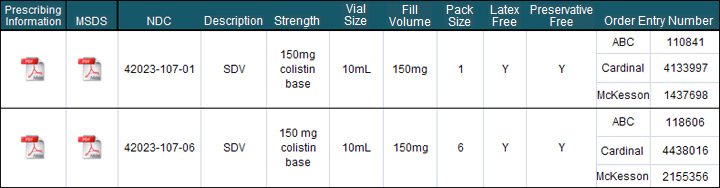
Product Profile:
- Latex Free
- Preservative Free
- Bar Coded
Description
Coly-Mycin® M Parenteral (colistimethate for injection, USP) is a sterile parenteral antibiotic product which, when reconstituted is suitable for intramuscular or intravenous administration. Each vial contains colistimethate sodium or pentasodium colistin-methanesulfonate (150 mg colistin base activity).
Indications and Usage
Coly-Mycin® M Parenteral is indicated for the treatment of acute or chronic infections due to sensitive strains of certain gram-negative bacilli. It is particularly indicated when the infection is caused by sensitive strains of Pseudomonas aeruginosa. This antibiotic is not indicated for infections due to Proteus or Neisseria. Coly-Mycin® M Parenteral has proven clinically effective in treatment of infections due to the following gram-negative organisms: Enterobacter aerogenes, Escherichia coli, Klebsiella pneumoniae, and Pseudomonas aeruginosa.
Coly-Mycin® M Parenteral may be used to initiate therapy in serious infections that are suspected to be due to gram-negative organisms and in the treatment of infections due to susceptible gram-negative pathogenic bacilli.
Contraindications
The use of Coly-Mycin® M Parenteral is contraindicated for patients with a history of sensitivity to the drug or any of its components.
Warnings
Maximum daily dose should not exceed 5 mg/kg/day (2.3 mg/lb) with normal renal function.
Transient neurological disturbances may occur. These include circumoral paresthesia or numbness, tingling or formication of the extremities, generalized pruritus, vertigo, dizziness, and slurring of speech. For these reasons, patients should be warned not to drive vehicles or use hazardous machinery while on therapy. Reduction of dosage may alleviate symptoms. Therapy need not be discontinued, but such patients should be observed with particular care.
Nephrotoxicity can occur and is probably a dose-dependent effect of colistimethate sodium. These manifestations of nephrotoxicity are reversible following discontinuation of the antibiotic.
Overdosage can result in renal insufficiency, muscle weakness, and apnea (see OVERDOSAGE section of Prescribing Information). See PRECAUTIONS, Drug Interactions subsection of Prescribing Information for use concomitantly with other antibiotics and curariform drugs.
Respiratory arrest has been reported following intramuscular administration of colistimethate sodium. Impaired renal function increases the possibility of apnea and neuromuscular blockade following administration of colistimethate sodium. Therefore, it is important to follow recommended dosing guidelines.
See DOSAGE AND ADMINISTRATION section of Prescribing Information for use in renal impairment.
Clostridium difficile associated diarrhea (CDAD) has been reported with nearly all antimicrobial agents including Coly-Mycin® M Parenteral and may range in severity from mild diarrhea to fatal colitis. Treatment with antibacterial agents alters the normal flora of the colon leading to overgrowth of C. difficile. C. difficile produces toxins A and B, which contribute to the development of CDAD. Hypertoxin producing strains of C. difficile cause increased morbidity and mortality, as these infections can be refractory to antimicrobial therapy and may require colectomy. CDAD must be considered in all patients who present with diarrhea following antibiotic use. Careful medical history is necessary since CDAD has been reported to occur over two months after the administration of antibacterial agents. If CDAD is suspected or confirmed, ongoing antibiotic use not directed against C. difficile may need to be discontinued. Appropriate fluid and electrolyte management, protein supplementation, antibiotic treatment of C. difficile, and surgical evaluation should be instituted as clinically indicated.
Adverse Events
The following adverse reactions have been reported:
Gastrointestinal: gastrointestinal upset
Nervous System: tingling of extremities and tongue, slurred speech, dizziness, vertigo and paresthesia
Integumentary: generalized itching, urticaria and rash
Body as a Whole: fever
Laboratory Deviations: increased blood urea nitrogen (BUN), elevated creatinine and decreased creatinine clearance
Respiratory System: respiratory distress and apnea
Renal System: nephrotoxicity and decreased urine output
Please see the full prescribing information link above for additional information.
| MK133A |