
Brevital Sodium (methohexital sodium for injection, USP)
Brevital® Sodium (methohexital sodium for injection, USP)
Product Summary
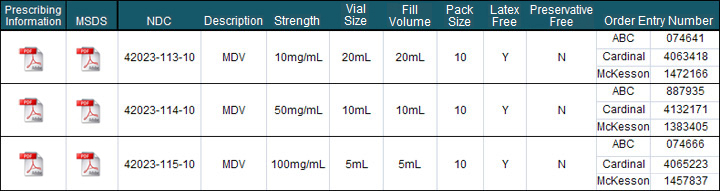
Product Profile:
- Latex Free
- Preservative Free
- Bar Coded
- Controlled Drug Schedule IV
| WARNING Brevital should be used only in hospital or ambulatory care settings that provide for continuous monitoring of respiratory (e.g. pulse oximetry) and cardiac function. Immediate availability of resuscitative drugs and age- and size-appropriate equipment for bag/valve/mask ventilation and intubation and personnel trained in their use and skilled in airway management should be assured. For deeply sedated patients, a designated individual other than the practitioner performing the procedure should be present to continuously monitor the patient. (See WARNINGS) |
- Rapid Onset of Action Intravenous administration of methohexital results in rapid uptake by the brain (within 30 seconds) and rapid induction of sleep.
- Short Duration of Effect The induction dose of Brevital® Sodium usually provides anesthesia for 5 to 7 minutes.
For additional detailed information on product, including a downloadable Preparation and Dosing Guide please visit the Brevital® Sodium Product Website at www.brevital.com
Description
A rapid, ultrashort-acting barbiturate anesthetic. Brevital® Sodium for injection is a freeze-dried, sterile, nonpyrogenic mixture of methohexital sodium with 6% anhydrous sodium carbonate added as a buffer. It contains not less than 90% and not more than 110% of the labeled amount of methohexital sodium. It occurs as a white, freeze-dried plug that is freely soluble in water.
This product is oxygen sensitive. The pH of the 1% solution is between 10 and 11; the pH of the 0.2% solution in 5% dextrose is between 9.5 and 10.5.
Indications and Usage
Brevital® Sodium can be used in adults as follows:
- For intravenous induction of anesthesia prior to the use of other general anesthetic agents.
- For intravenous induction of anesthesia and as an adjunct to subpotent inhalational anesthetic agents (such as nitrous oxide in oxygen) for short surgical procedures; Brevital® Sodium may be given by infusion or intermittent injection.
- For use along with other parenteral agents, usually narcotic analgesics, to supplement subpotent inhalational anesthetic agents (such as nitrous oxide in oxygen) for longer surgical procedures.
- As intravenous anesthesia for short surgical, diagnostic, or therapeutic procedures associated with minimal painful stimuli (see WARNINGS of Prescribing Information).
- As an agent for inducing a hypnotic state.
Brevital® Sodium can be used in pediatric patients older than 1 month as follows:
- For rectal or intramuscular induction of anesthesia prior to the use of other general anesthetic agents.
- For rectal or intramuscular induction of anesthesia and as an adjunct to subpotent inhalational anesthetic agents for short surgical procedures.
- As rectal or intramuscular anesthesia for short surgical, diagnostic, or therapeutic procedures associated with minimal painful stimuli.
Contraindications
Brevital® Sodium is contraindicated in patients in whom general anesthesia is contraindicated, in those with latent or manifest porphyria, or in patients with a known hypersensitivity to barbiturates.
Warnings
See boxed Warning. As with all potent anesthetic agents and adjuncts, Brevital® Sodium should be used only in hospital or ambulatory care settings that provide for continuous monitoring of respiratory (e.g. pulse oximetry) and cardiac function. Immediate availability of resuscitative drugs and age- and size-appropriate equipment for bag/valve/mask ventilation and intubation and personnel trained in their use and skilled in airway management should be assured. For deeply sedated patients, a designated individual other than the practitioner performing the procedure should be present to continuously monitor the patient.
Maintenance of a patent airway and adequacy of ventilation must be ensured during induction and maintenance of anesthesia with methohexital sodium solution. Laryngospasm is common during induction with all barbiturates and may be due to a combination of secretions and accentuated reflexes following induction or may result from painful stimuli during light anesthesia. Apnea/hypoventilation may be noted during induction, which may impair pulmonary ventilation; the duration of apnea may be longer than that produced by other barbiturate anesthetics. Cardiorespiratory arrest may occur.
The full prescribing information describes intravenous use of methohexital sodium in adults. It also discusses intramuscular and rectal administration in pediatric patients older than one month. Although the published literature discusses intravenous administration in pediatric patients, the safety and effectiveness of intravenous administration of methohexital sodium in pediatric patients have not been established in well-controlled, prospective studies. (See PRECAUTIONS —Pediatric Use section of Prescribing Information)
Seizures may be elicited in subjects with a previous history of convulsive activity, especially partial seizure disorders.
Because the liver is involved in demethylation and oxidation of methohexital and because barbiturates may enhance preexisting circulatory depression, severe hepatic dysfunction, severe cardiovascular instability, or a shock-like condition may be reason for selecting another induction agent.
Prolonged administration may result in cumulative effects, including extended somnolence, protracted unconsciousness, and respiratory and cardiovascular depression. Respiratory depression in the presence of an impaired airway may lead to hypoxia, cardiac arrest, and death.
The CNS-depressant effect of Brevital® Sodium may be additive with that of other CNS depressants, including ethyl alcohol and propylene glycol.
DANGER OF INTRA-ARTERIAL INJECTION—Unintended intra-arterial injection of barbiturate solutions may be followed by the production of platelet aggregates and thrombosis, starting in arterioles distal to the site of injection. The resulting necrosis may lead to gangrene, which may require amputation. The first sign in conscious patients may be a complaint of fiery burning that roughly follows the distribution path of the injected artery; if noted, the injection should be stopped immediately and the situation reevaluated. Transient blanching may or may not be noted very early; blotchy cyanosis and dark discoloration may then be the first sign in anesthetized patients. There is no established treatment other than prevention. (see full prescribing information for additional information on intra-arterial injection.
Adverse Events Side Effects associated with Brevital® Sodium are extensions of pharmacologic effects and include:
Cardiovascular—Circulatory depression, thrombophlebitis, hypotension, tachycardia, peripheral vascular collapse, and convulsions in association with cardiorespiratory arrest.
Respiratory—Respiratory depression (including apnea), cardiorespiratory arrest, laryngospasm, bronchospasm, hiccups, and dyspnea.
Neurologic—Skeletal muscle hyperactivity (twitching), injury to nerves adjacent to injection site, and seizures.
Psychiatric—Emergence delirium, restlessness, and anxiety may occur, especially in the presence of postoperative pain.
Gastrointestinal—Nausea, emesis, abdominal pain, and liver function tests abnormal.
Allergic—Erythema, pruritus, urticaria, and cases of anaphylaxis have been reported rarely.
Other—Other adverse reactions include pain at injection site, salivation, headache, and rhinitis.
Please see the full prescribing information link above for additional information.
| MK110D |